How Dashers Track Real Profit
If you’ve ever ended a DoorDash shift feeling good about your earnings, only to wonder later why your bank balance didn’t reflect it, you’re not alone. This is one of the most common frustrations among drivers, especially those who are new or trying to increase their income.
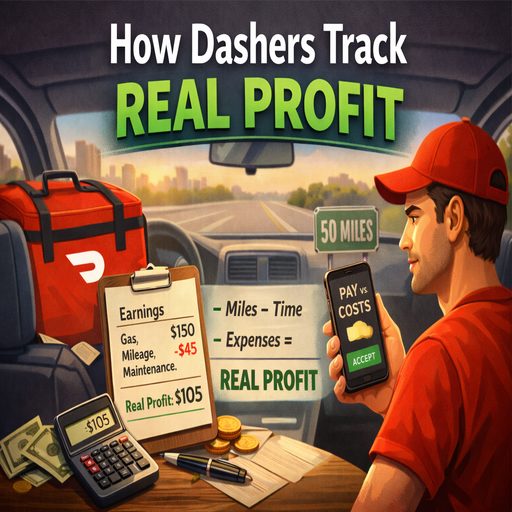
The problem isn’t that DoorDash is lying to you. The problem is that most drivers are tracking earnings, not profit — and those are two very different things.
Earnings look good on the screen.
Profit is what you actually keep.
Once drivers understand the difference, everything about how they accept orders starts to change.
Why DoorDash earnings don’t tell the full story
When DoorDash shows you your earnings, it includes base pay, tips, and occasional adjustments. On the surface, that feels like real money earned. But none of those numbers account for what it costs you to complete those deliveries.
Every mile you drive costs money. Gas is the obvious expense, but it doesn’t stop there. Oil changes, tires, brakes, maintenance, depreciation, and even insurance increases all add up over time. Many experienced drivers estimate their true vehicle cost somewhere between thirty and sixty cents per mile. If you’re not subtracting that, you’re overestimating how much you’re actually making.
Time is another hidden cost. DoorDash often highlights “active time,” but that ignores waiting for offers, driving back to busy zones or dealing with traffic. When you factor in total time, your real hourly rate is often much lower than what the app suggests.
This is why a shift that looks great on paper can feel disappointing afterward. The money wasn’t fake — but the picture was incomplete.
The shift from earnings to profit
Drivers who last long-term almost always make the same mental shift. They stop asking, “How much does this order pay?” and start asking, “Is this order worth it?”
That change alone separates drivers who burn out from drivers who stay profitable.
Instead of focusing on totals at the end of the day, experienced drivers look at each order as a small business decision. They evaluate how much distance it requires, how long it will realistically take, and whether it fits their personal thresholds.
Profit isn’t about chasing the biggest payout on the screen. It’s about consistency.
How profitable drivers actually track profit
Most profitable drivers rely on a combination of mileage awareness, time awareness, and pattern tracking.
The first thing many drivers adopt is a minimum pay-per-mile rule. This gives them a quick way to filter bad orders before emotion gets involved. Some drivers won’t move for less than a $1.50 per mile. Others aim for $2.00 per mile or more, depending on their market and expenses. The exact number matters less than having a rule and sticking to it.
Time is the second filter. A $10.00 order can be a great choice or a terrible one depending on how long it takes. Restaurant speed, traffic, apartment drop-offs, and stacked orders all affect real profit. Drivers who think in terms of time quickly realize that a slightly lower-paying order that finishes fast often beats a higher-paying one that drags on.
Finally, profitable drivers look at trends over time, not just individual shifts. Weekly tracking shows which zones, times of day, and order types consistently produce profit and which ones quietly drain it. This perspective makes it easier to adjust strategy instead of guessing.
Why mental math eventually fails
In the beginning, most drivers do this analysis in their head. They divide pay by miles, estimate time, and go with their gut. That works — for a while.
Over longer shifts or busy weeks, fatigue sets in. Stacked orders get harder to evaluate. One bad decision leads to another. Small mistakes start adding up, and suddenly a decent-looking week feels underwhelming.
This is where many drivers either get frustrated and quit, or they look for ways to remove guesswork from the process.
Turning consistency into a system
Some drivers move to spreadsheets or notes apps to track mileage and earnings. Others use mileage trackers alongside manual calculations. These methods are better than guessing, but they still require effort and attention — something that’s hard to maintain while driving.
That’s why some drivers choose to automate parts of the decision-making process. Helper tools can analyze the DoorDash offer screen, apply personal thresholds, and keep decisions consistent without relying on mental math every time. Tools like Drivers Utility Helper (DUH) exist for this reason — not to exploit the system, but to help drivers protect their time, vehicle, and income.
Automation isn’t about doing less thinking. It’s about doing the thinking once, then letting a system enforce it consistently.
The takeaway most drivers wish they learned earlier
DoorDash earnings are not useless — they’re just incomplete. If you only look at what the app shows you, you’re missing the costs that matter most.
Drivers who focus on profit track miles, time, and patterns. They make decisions based on rules, not emotions. Over time, that approach turns DoorDash from a gamble into a predictable strategy.
At the end of the day, earnings are what DoorDash shows you.
Profit is what you actually keep.
Once you start tracking the right number, everything else gets easier.